Be yourself; Everyone else is already taken.
— Oscar Wilde.
This is the first post on my new blog. I’m just getting this new blog going, so stay tuned for more. Subscribe below to get notified when I post new updates.
Be yourself; Everyone else is already taken.
— Oscar Wilde.
This is the first post on my new blog. I’m just getting this new blog going, so stay tuned for more. Subscribe below to get notified when I post new updates.
Here is where you can find the video for my PoE:
A digital footprint could be a problem, this problem can be evident when someone is going for a job interview. Most people nowadays have social media from when they were younger. Posts that they may have posted in 2010 could affect if they would get the job or not because companies will think if that is the image that they would like for their company.
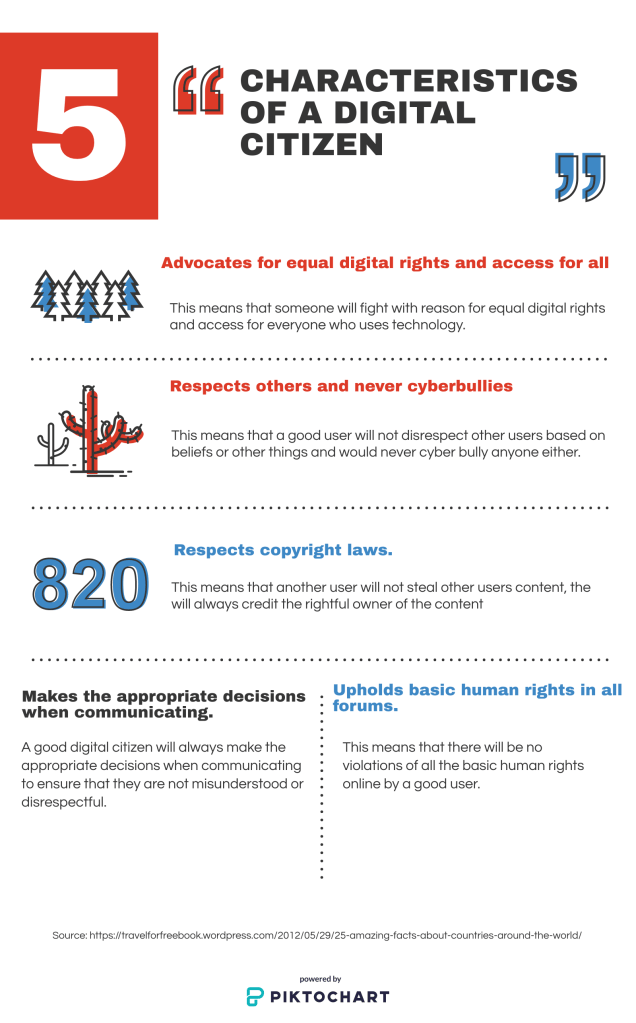
A digital citizen is someone who abides to the norms of the appropriate, responsible behaviour when using technology. (IIE, 2019)
Social media users are creating social capital, we are only enhancing social capital. During the process of creating social capital, there is an improvement in social and communication skills. (IIE, 2019)
The first element is Digital Access. According to Ribble (2011), Digital access is key and critical to bringing these social and economic benefits and should be at the forefront of all business and government decision-making in the context of creating opportunities. Digital Access sees issues such as the digital divide that is broken up into a socio-economic divide, infrastructure divide, a content divide, gender divide and a skills divide. (IIE, 2019)
The second element is digital commerce, this is the buying and selling of products and services through the internet. Digital Commerce includes research, development, servicing, marketing, selling and buying products for all devices and platforms including desktop, mobile/tablet, social networks. (Kohler, Alvarez, 2014)
The third element is digital communication, this is the electronic exchange of information. (IIE,2019)
The fourth element is digital literacy, this is the ability to find, evaluate, interpret, utilise, share and create content using information technologies as well as the internet. (IIE, 2019)
The fifth element is digital etiquette, this is how someone should act when using the internet and devices. Web pages and Websites often have privacy policies, as well as behavioural policies that users have to agree to before using their servers. (IIE, 2019)
The sixth element is digital law, according to Digiteen (2014) it is “defined as the electronic responsibility for actions, deeds which is either ethical or unethical” (Digiteen, 2014) (IIE, 2019)
The seventh element is Digital rights and responsibilities. This is the requirements and freedom that is extended to users in the digital world. (IIE,2019)
The eight element is digital health and wellness. This is how the user is physically and psychologically affected by the use of digital products and services. In most cases the physical affect is RSI (Repetitive Strain Injury). (IIE, 2019)
The ninth element is digital security, this is taking necessary precautions to ensure a safe digital environment. (IIE, 2019)
19005143- This is going to be an education blog by Camryn-Paige Roberts
This is an example post, originally published as part of Blogging University. Enroll in one of our ten programs, and start your blog right.
You’re going to publish a post today. Don’t worry about how your blog looks. Don’t worry if you haven’t given it a name yet, or you’re feeling overwhelmed. Just click the “New Post” button, and tell us why you’re here.
Why do this?
The post can be short or long, a personal intro to your life or a bloggy mission statement, a manifesto for the future or a simple outline of your the types of things you hope to publish.
To help you get started, here are a few questions:
You’re not locked into any of this; one of the wonderful things about blogs is how they constantly evolve as we learn, grow, and interact with one another — but it’s good to know where and why you started, and articulating your goals may just give you a few other post ideas.
Can’t think how to get started? Just write the first thing that pops into your head. Anne Lamott, author of a book on writing we love, says that you need to give yourself permission to write a “crappy first draft”. Anne makes a great point — just start writing, and worry about editing it later.
When you’re ready to publish, give your post three to five tags that describe your blog’s focus — writing, photography, fiction, parenting, food, cars, movies, sports, whatever. These tags will help others who care about your topics find you in the Reader. Make sure one of the tags is “zerotohero,” so other new bloggers can find you, too.
Have a WordPress.com account? Log in now.